
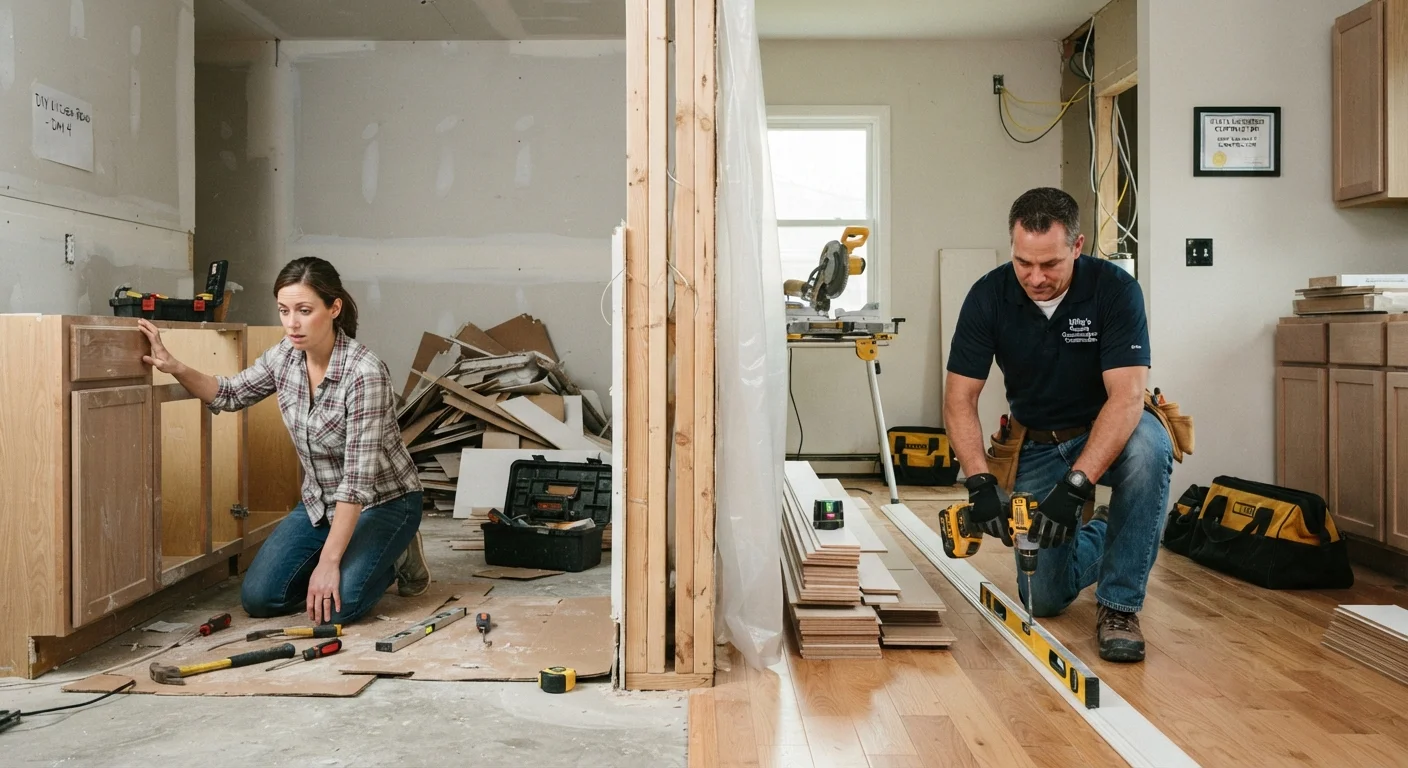
What actually goes into the DIY vs. pro decision
The appeal of doing a repair yourself is straightforward: you avoid labor costs, which can account for 40 to 60 percent of a typical contractor invoice. But the decision involves more than a single number. You need to weigh your current skill level honestly, the physical and legal consequences of an error, the cost of tools you do not already own, and whether the work requires a permit.
Permits matter more than many homeowners realize. In most U.S. jurisdictions, electrical panel work, structural modifications, HVAC installation, and plumbing that connects to the main supply line all require a permit and inspection. Unpermitted work can affect your homeowner's insurance coverage and complicate a future home sale. The general rule is: if a jurisdiction requires a licensed trade to pull a permit for a job, that job belongs with a licensed professional.
For tasks that fall outside that category, the calculation shifts. Replacing a light fixture on a circuit you have properly de-energized, patching drywall, painting, fixing a leaky faucet on a shutoff-accessible supply line, or re-caulking a tub are all tasks a careful, attentive homeowner can learn and complete safely. Curb appeal projects like basic yard work sit firmly in this approachable category for most families.
The real cost of DIY, including the parts people overlook
A DIY repair looks cheaper on paper until you account for everything. Materials often cost more when purchased in small quantities at a retail store than they do for a contractor buying in bulk with trade discounts. A single specialty tool you need only once, such as a pipe threading kit or a tile wet saw, can cost more to buy than to include in a professional quote.
Time is the other hidden variable. A task a plumber completes in two hours may take a first-time DIYer a full weekend, including at least one additional hardware store trip. If that time has meaningful value in your household, the math changes. Factor in the probability of a mistake that requires a professional to undo and redo your work, which generally costs more than having the pro do it once from the start.
Low-stakes repairs are good practice
Cosmetic work such as painting, caulking, and minor patching is forgiving. A poor result costs little to redo, and the experience gained on these tasks prepares you to judge more complex repairs accurately. Starting with low-consequence projects is a practical way to build realistic confidence without financial risk.
That said, experience compounds. A homeowner who patches drywall once learns enough to do it faster and better the second time. Low-stakes repairs are good practice, especially when the cost of a poor result is limited to appearance and a few dollars of materials.
Insulation is one area where myths about difficulty and risk lead many homeowners to overspend on professionals for work they could handle safely. Common insulation misconceptions about R-value and vapor barriers are worth understanding before you hire out that work.
Where DIY carries genuine risk
Some categories of repair create hazards that go beyond a bad-looking result. Live electrical work, gas line repairs, load-bearing wall modifications, roof structural work, and asbestos or lead paint disturbing projects all carry potential for serious injury, fire, or structural failure. These are not tasks where watching a few instructional videos is adequate preparation.
Even if you feel confident, liability is a separate issue. If unpermitted electrical work contributes to a house fire, your insurance company may deny the claim. If you modify a load-bearing element incorrectly, the problem may not appear for months or years, and the repair bill at that point will be substantial. The same logic that applies to deferred car maintenance applies here: cutting corners on a structural or safety-critical repair rarely produces long-term savings.
For work in these categories, the practical approach is to get at least two contractor quotes, understand what the permit process involves, and ask the contractor to explain what the inspection will cover. A professional who avoids permits or discourages you from pulling one is not saving you money; they are transferring the legal risk to you.
Labor cost savings on straightforward tasks
Cosmetic and low-risk repairs can eliminate the labor portion of the bill, which commonly represents the majority of a contractor's invoice on simple jobs.
Builds useful skills over time
Completing basic repairs yourself builds a practical knowledge base that makes future tasks faster and reduces dependency on outside help for minor issues.
Flexible scheduling on your own timeline
You are not waiting for a contractor's availability, which matters when a repair is cosmetic or when your schedule makes coordinating trades difficult.
Direct control over materials and methods
You can select the exact materials you want and verify the work firsthand, rather than relying on a contractor's material choices or subcontractors.
Mistakes can cost more than the original repair
A DIY error on plumbing, tile, or drywall often requires a professional to undo the incorrect work before redoing it correctly, resulting in a higher total cost than hiring out from the start.
Permitted and regulated work requires licensed trades
Electrical panel work, structural changes, and gas connections require permits in most jurisdictions. Unpermitted work can affect insurance coverage and complicate home sales.
Tool and material costs reduce savings on one-time jobs
Specialty tools needed for a single repair can eliminate the labor savings, particularly when contractors receive trade discounts on materials that retail buyers do not.
Safety hazards in high-risk repair categories
Electrical, gas, structural, and hazardous-material work carries injury risk that experience alone does not reliably mitigate without proper training and safety equipment.
Time investment is frequently underestimated
First-time repairs almost always take longer than anticipated, including research time, supply runs, and troubleshooting, which affects the practical value of the labor savings.
How to decide on any specific repair
A straightforward set of questions helps frame most decisions. First, does the work require a permit in your municipality? If yes, a licensed contractor is almost always the correct path. Second, what is the worst realistic outcome if the repair fails, and is that outcome something you can live with and afford to fix? A poorly painted wall is an inconvenience. A poorly installed water heater is a safety hazard.
Third, do you have the specific tools and a realistic path to the skills the job requires? There is a difference between a skill you can learn in an afternoon with modest materials and one that takes years of trade experience to perform safely. Honest self-assessment here prevents the most expensive DIY mistakes.
Finally, consider your time budget. If the repair is needed urgently, a contractor who can complete the work correctly in a day is often worth the labor cost, even for tasks that are technically within a homeowner's ability. Low-urgency projects like landscaping are much more forgiving of a learning curve.
40-60%
Labor share of a typical contractor invoice
Industry cost breakdowns for common residential repair trades consistently show labor at roughly half or more of the total project cost.
1 in 3
DIY home repair projects requiring a professional fix
Surveys of homeowners who attempted repairs themselves have found that roughly one-third required a professional to correct or complete the work afterward.