
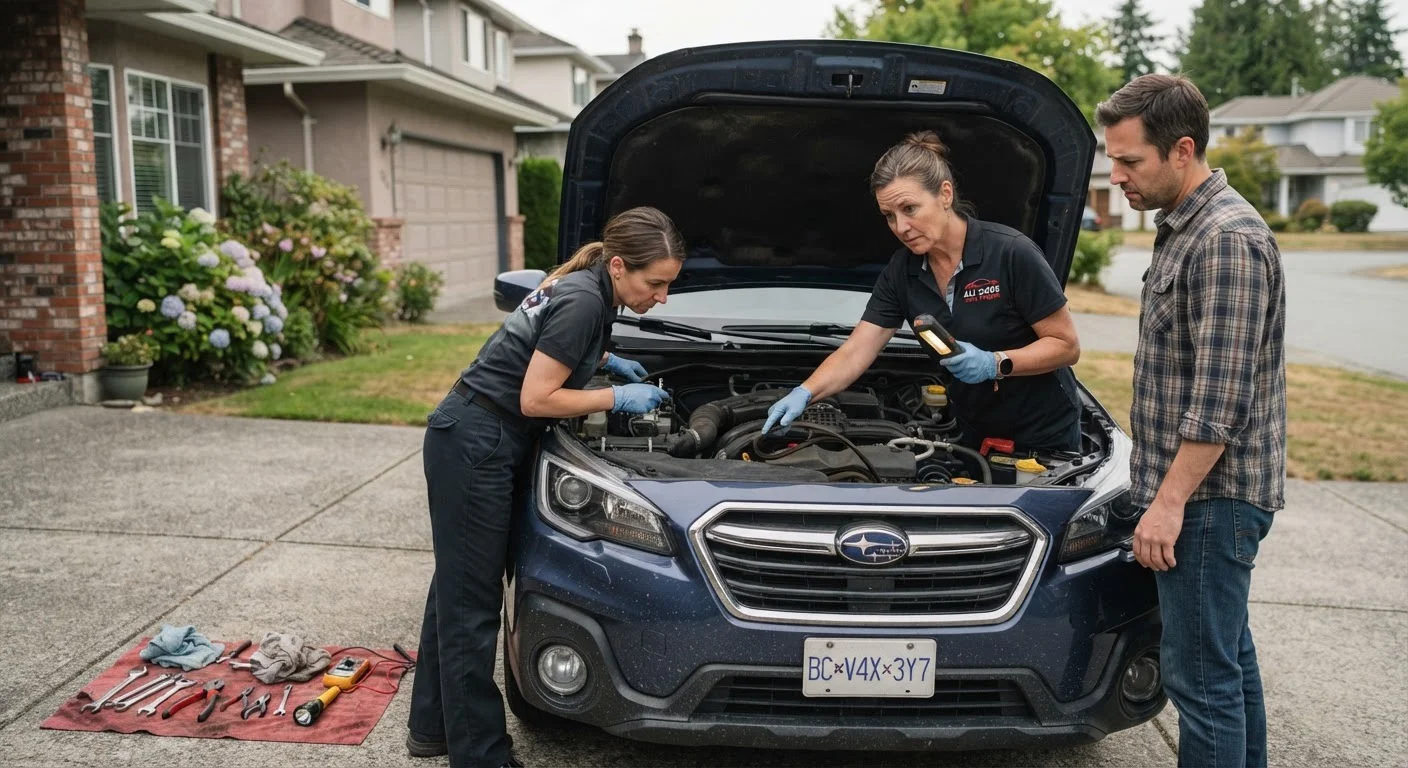
How one skipped service becomes a chain of failures
Car systems do not fail in isolation. A timing belt that goes unserviced past its recommended interval does not simply snap on its own terms: it can destroy intake valves, bend pushrods, and score cylinder walls in the same event. What the manufacturer prices as a $400 to $600 belt replacement can become a $2,000 to $4,000 engine repair if the belt fails rather than being proactively changed.
The same logic applies to engine oil. Oil breaks down over time and accumulates combustion byproducts. Running an engine on degraded oil increases wear on bearings, camshaft lobes, and piston rings. Those components do not send a warning light before they wear past safe tolerances; by the time a symptom appears, the damage is done.
Families who treat maintenance as optional spending often find that their total repair bills over a five-year period far exceed what consistent upkeep would have cost. This is not a coincidence. It is how mechanical systems behave when stress accumulates unchecked.
Check your owner's manual first
Before assuming a service item can wait, look up the manufacturer's recommended interval in the owner's manual. Many owners discover they are already past the recommended mileage for several items. Knowing that fact early gives you time to schedule and budget rather than react to a failure.
The repairs with the highest financial risk when delayed
Not every deferred item carries equal consequence. Some systems are more forgiving than others. These four are the ones where delay most reliably produces expensive secondary damage.
- Cooling system: A small coolant leak or a worn thermostat costs little to fix. If ignored, the engine can overheat. Overheating warps cylinder heads and can crack engine blocks, producing repair bills that often exceed the car's market value.
- Brakes: Worn brake pads grind into rotors. Replacing pads alone typically costs $150 to $300 per axle; replacing pads and rotors together can run $400 to $700. Beyond cost, degraded brakes are a direct safety concern.
- Transmission fluid: Transmission fluid degrades and collects metal particles over time. Skipping fluid changes accelerates internal wear. A full transmission rebuild or replacement is one of the most expensive repairs on any vehicle, often $2,500 to $5,000 or more.
- Timing belt or chain: Described above, but worth repeating: this is the repair where delay most often produces catastrophic engine damage rather than incremental wear.
For families managing tight budgets, see car ownership costs families underestimate for a broader picture of where vehicle expenses tend to surprise owners.
$1,200+
Average additional repair cost from a single overheating event
AAA's vehicle repair research has documented that engine overheating caused by neglected cooling systems is among the costliest preventable failures for passenger vehicles.
2x to 5x
Typical cost multiplier when a deferred repair causes secondary failure
Industry repair data consistently shows that compounding failures, where one neglected component damages adjacent systems, multiply original repair costs by two to five times or more.
$150 to $200
Average U.S. towing fee added during an unplanned breakdown
This cost is separate from the repair itself and is avoidable when maintenance keeps a vehicle from failing on the road.
The hidden costs beyond the repair itself
A breakdown caused by deferred maintenance does not just produce a repair bill. It produces a sequence of costs that compound the original expense.
Towing fees in most U.S. markets run $75 to $200 for a standard tow. If the vehicle breaks down far from home, that figure rises. A rental car while the vehicle is in the shop adds $40 to $80 per day in many markets. Lost wages from missed work, missed pickups, and schedule disruption are harder to quantify but real.
There is also the question of negotiating leverage. A car brought in for a planned, non-urgent repair gives the owner time to get multiple estimates. A car that arrives on a flatbed needs work immediately, which limits the owner's ability to compare shops or wait for a better price. Finding a trustworthy mechanic matters far more when you are not under pressure to accept the first estimate offered.
Building a simple system to stay ahead of overdue maintenance
The owner's manual is the most reliable guide to service timing. Every major interval, oil changes, spark plugs, transmission fluid, coolant flush, timing belt, is listed there with mileage or time-based triggers. Most owners do not need an elaborate tracking system; a note in the glovebox or a free spreadsheet on a phone is enough to stay current.
Mileage-based tracking works better than calendar-based tracking for most families, because driving habits vary. A vehicle driven 20,000 miles per year needs oil changes roughly twice as often as one driven 10,000 miles per year.
For high-mileage vehicles, the stakes are higher because multiple systems may be approaching their service limits simultaneously. Keeping a car running past 150,000 miles covers the specific maintenance priorities that matter most once the odometer climbs.
When a repair is genuinely unaffordable right now, ask a mechanic to prioritize the list. Safety-critical items and anything with compounding failure risk should come first; cosmetic and comfort items can wait. That conversation is more useful than skipping the inspection entirely.
When budgets are tight, prioritize safety systems
If you cannot address every overdue item at once, brakes, steering, tires, and anything affecting engine cooling should come before other repairs. These systems affect both safety and the probability of expensive secondary failures. Cosmetic repairs and comfort features can reasonably wait when money is limited.