
Why these three products get confused
Walk into any home improvement store and the caulk-and-grout aisle presents dozens of tubes, buckets, and bottles with overlapping names. Many are labeled 'tile and grout,' 'grout sealant,' or 'tub and tile caulk,' which blurs the lines between three products that have distinct jobs. Picking the wrong one for a specific location does not just look bad; it can allow water to seep behind tiles, feed mold growth inside walls, and lead to repairs that cost far more than the original project.
The confusion is understandable because all three products work in wet environments and all three deal with gaps or joints. The difference is mechanical: grout is rigid, caulk is flexible, and sealant is a surface protectant. Each belongs in a specific location, and substituting one for another at the wrong spot is a common source of bathroom repair problems.
Where grout belongs
Grout fills the joints between individual tiles. It is mixed as a paste, pressed into the gaps with a float, and cured to a hard finish. That hardness is exactly what makes it appropriate between tiles on a flat wall or floor: there is very little movement in those joints, and the rigidity keeps tiles aligned and protects the edges from chipping.
Cement-based grout comes in sanded and unsanded varieties. Sanded grout is used for joints wider than about 1/8 inch because the sand filler prevents shrinkage cracking. Unsanded grout is smoother and works better for narrow joints or polished stone tiles that sanded grout could scratch. Epoxy grout is a third option: it is harder, stain-resistant, and does not require sealing, but it is also more expensive and significantly harder to work with during installation.
Grout is not a flexible material
Cement-based grout has virtually no elasticity once cured. Any location subject to movement, deflection, or thermal cycling needs a flexible caulk instead. This includes all inside corners in a shower, the joint at the base of a tub surround, and any seam where two different materials meet.
Grout should never be applied at inside corners, at the joint where a tile wall meets a tub deck, or where tile meets a different material such as wood or metal trim. Those are movement joints that need caulk.
Where caulk belongs
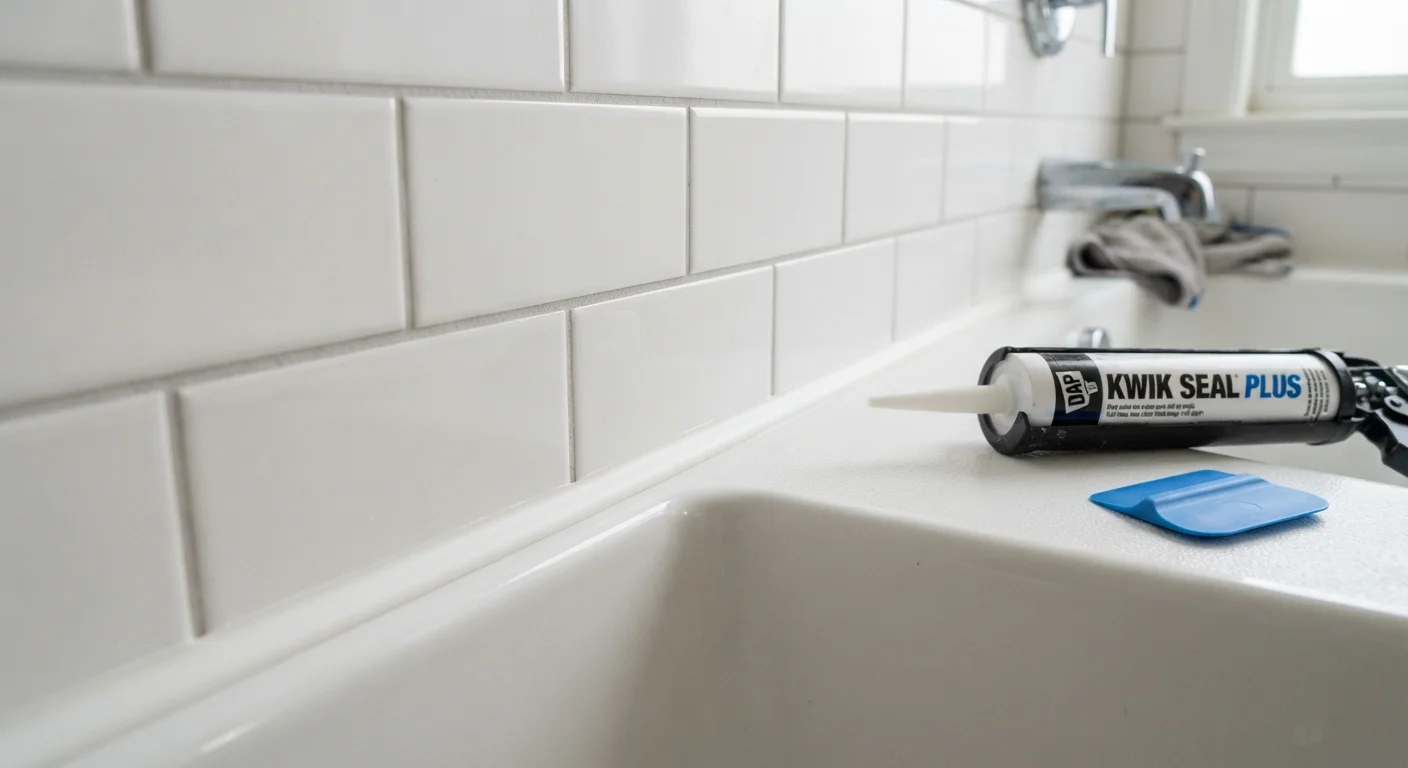
Caulk is the right material wherever two surfaces meet at an angle, wherever dissimilar materials meet, or wherever movement is expected. In a bathroom, the most common caulk locations are: the perimeter joint between a bathtub or shower pan and the tile wall above it, inside shower corners, the joint between tile and a window sill, and the seam where tile meets a countertop or floor transition.
The tile industry's published installation standards, including those from the Tile Council of North America, specifically call for flexible sealant at these locations instead of grout. A home settles, temperatures fluctuate, and a cast-iron or acrylic tub flexes under the weight of water. Grout at those joints cracks within months. Caulk absorbs that movement and keeps the seal intact.
For permanently wet areas, 100% silicone caulk holds up longer than acrylic or siliconized latex. Silicone caulk does not accept paint, is harder to tool smoothly, and requires mineral spirits for cleanup, so some homeowners opt for a high-quality siliconized latex in lower-stress locations. Matching caulk color to the grout gives a cleaner look. Most grout manufacturers sell color-matched caulk in the same product line. For more on sealing gaps in other parts of the house, see how caulk is used around doors and windows.
What grout sealant actually does
Grout sealant is not a gap filler at all. It is a liquid coating brushed or rolled over the surface of cured cement-based grout to reduce its porosity. Without sealant, cement grout absorbs water, soap residue, and oils that discolor it and can feed mold over time.
Penetrating sealants soak into the grout and create a barrier below the surface without changing the appearance. Topical sealants sit on the surface and can add a slight sheen. Penetrating sealants are generally preferred in high-traffic or wet areas because they do not peel.
Applying grout sealant is a straightforward maintenance task. The grout must be fully cured and clean before application. Most products are applied with a small brush or applicator bottle along each grout line, then wiped off the tile face before drying. One or two coats are typical. The process needs to be repeated periodically, generally every one to three years in a bathroom, depending on how much the shower or tub is used.
A practical guide to which goes where
Here is a simple way to decide before starting any tile work or repair:
- Joints between tiles on a flat wall or floor: grout.
- Inside corners in a shower or tub surround: caulk.
- The perimeter seam where tile meets the tub or shower pan: caulk.
- Where tile meets a different material (wood, metal, countertop): caulk.
- The surface of existing cement grout to prevent staining: grout sealant.
When doing a repair, remove whatever is in the joint first and identify why it failed before replacing it with the same material. Grout cracking in a corner means grout was used where caulk was needed. Caulk pulling away from tiles often means the surface was dirty or wet when it was applied. Discolored grout that has not cracked is typically a candidate for cleaning and re-sealing rather than removal.