
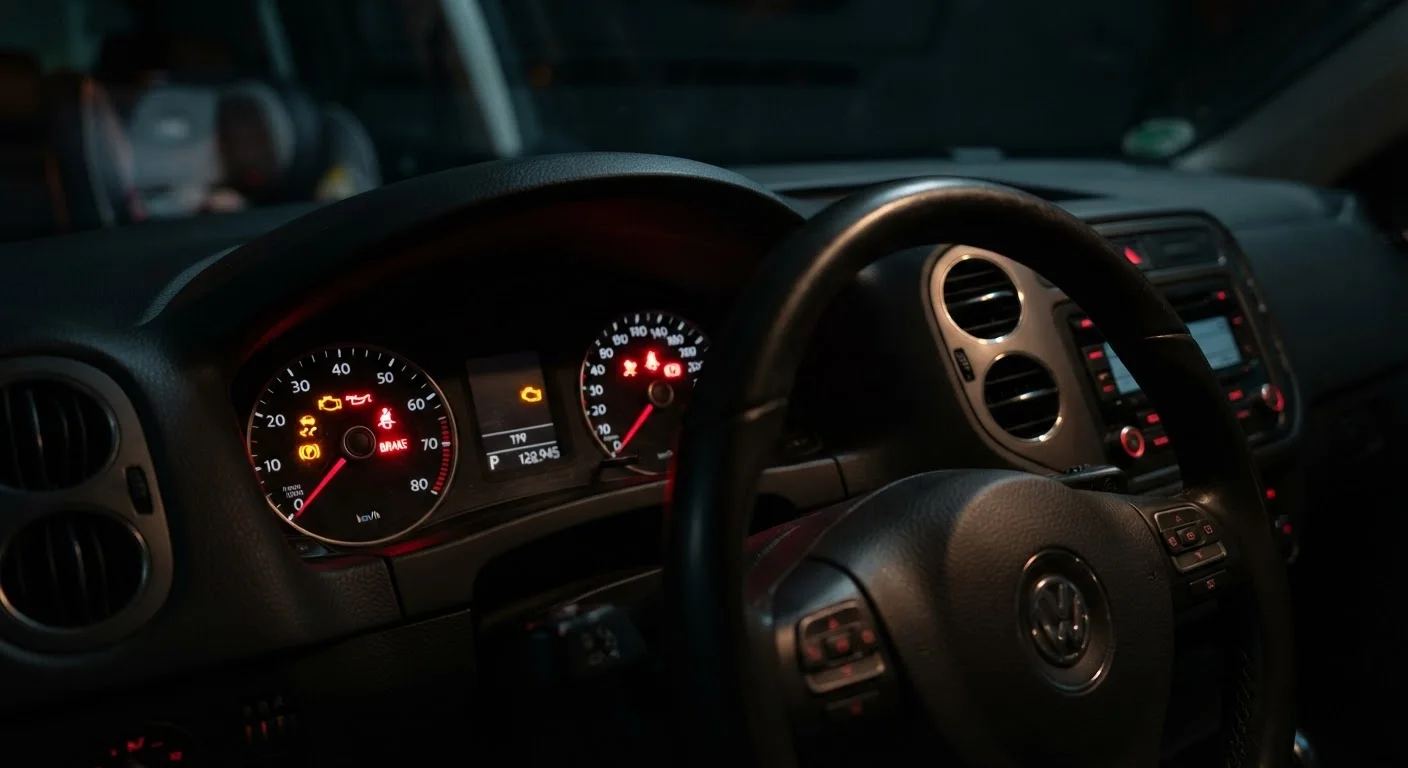
Why warning lights get ignored
Most families have driven at least a few miles with a warning light glowing on the dashboard. Sometimes the light turns off on its own. Sometimes nothing bad happens. Over time, that pattern trains drivers to treat warning lights as background noise rather than signals worth acting on.
That habit can be expensive. Some lights do flag minor issues that can wait until a scheduled service visit. Others signal conditions that will cause serious mechanical damage within minutes of continued driving. The cost difference between reacting promptly and waiting can run into thousands of dollars, as deferred maintenance compounds quickly.
The list below covers the lights families most commonly dismiss, along with a plain explanation of what each one actually means and when you need to act fast.
Oil pressure warning
This light, which usually looks like an old-fashioned oil can, signals that oil pressure in the engine has dropped below the minimum needed to keep moving parts lubricated. When metal components run without adequate lubrication, they wear against each other rapidly and generate extreme heat.
If this light turns on while driving, pull over safely and shut off the engine as soon as possible. Do not drive to the nearest shop. Check the oil level on the dipstick. If the level is normal, the issue may be a failing oil pump or a pressure sensor fault, either of which needs a mechanic before you drive further. If oil is low, add the correct grade and check for leaks before restarting. Continuing to drive with low oil pressure is one of the fastest ways to destroy an engine beyond repair.
Driving with low oil pressure can destroy an engine within minutes.
Engine temperature warning
The temperature gauge or coolant warning light shows that the engine is overheating. Engines operate within a specific thermal range; beyond that range, cylinder head gaskets can fail, aluminum components can warp, and in severe cases the engine block can crack.
Pull over, turn off the engine, and let it cool before opening the hood. Never open a hot radiator cap. Once cooled, check the coolant reservoir level. Common causes include a coolant leak, a failed water pump, or a stuck thermostat. Any of these conditions requires repair before the vehicle is driven again. Overheating damage is often not covered by standard warranties if it can be shown the driver continued operating the vehicle after the warning appeared.
Opening a hot radiator cap can cause severe burns; always wait for the engine to cool.
Check engine light
This is the light families most often dismiss, partly because it covers such a wide range of fault codes. The check engine light (formally the malfunction indicator lamp) can be triggered by something as minor as a loose gas cap or as serious as a misfiring cylinder or a failing catalytic converter.
A steadily lit check engine light generally means the issue is stored but not immediately critical. A flashing check engine light means the engine is actively misfiring, and continued driving can overheat and damage the catalytic converter, turning a modest repair into a repair costing several hundred dollars more. Any auto parts retailer can read the fault code for free. That code is not a repair order, but it tells you what system flagged the fault and helps you have an informed conversation with a mechanic.
A flashing check engine light means active misfiring; drive to a shop without delay.
Brake system warning
Many drivers see this light and assume the parking brake is still engaged. That is the first thing to check. If releasing the parking brake clears the light, no further action is needed right away. If the light stays on, the system is reporting a fault in the hydraulic brake circuit, which may include low brake fluid, a pressure imbalance between front and rear circuits, or a sensor failure.
Brakes are the single most important safety system on any vehicle. A hydraulic fault that causes one circuit to fail can leave the driver with significantly reduced stopping power. This light should be treated as urgent, not deferred to the next oil change. A qualified mechanic should inspect the brake system before the vehicle is driven extensively.
A brake warning that persists after releasing the parking brake needs same-day attention.
Tire pressure monitoring system (TPMS)
The TPMS light, a cross-section of a tire with an exclamation mark, illuminates when one or more tires drop significantly below the recommended inflation pressure. Underinflated tires wear unevenly, reduce fuel economy, and handle poorly in emergency maneuvers. In severe cases, an underinflated tire running at highway speed can overheat and fail.
This light does not always mean there is a slow leak. Tire pressure drops naturally in cold weather, roughly 1 PSI for every 10 degrees Fahrenheit of temperature decrease. Check the pressure in all four tires against the sticker inside the driver's door frame (not the maximum pressure printed on the tire sidewall). Inflate as needed and see whether the light clears. If a tire repeatedly loses pressure, inspect it for a nail or valve stem issue. For guidance on tire condition more broadly, see our article on tire safety and cost tradeoffs.
Check pressure against the door sticker, not the maximum number on the tire sidewall.
Battery or charging system warning
This light, which looks like a battery symbol, typically means the alternator is not supplying enough charge to keep the battery topped up while the engine runs. Once the battery drains below the threshold needed to power the ignition system and fuel pump, the vehicle will stall, often without warning.
When this light appears, limit electrical loads where possible: turn off the air conditioner, the rear defroster, and any non-essential accessories. Drive directly to a mechanic or a shop that can test the charging system. A failing alternator usually costs less to replace when caught early than when the battery is also fully discharged or damaged by repeated deep cycling. This is a light that families often defer because the car seems fine until it suddenly is not.
A charging system fault can strand the vehicle without warning when the battery drains completely.
Acting on what the lights are telling you
A warning light is not a suggestion to worry. It is the car's onboard monitoring system reporting a measured condition that falls outside normal parameters. Treating each light as information rather than alarm helps families respond proportionally rather than either panicking or ignoring the signal entirely.
Keep a small notebook in the glove box
When a warning light appears, note the date, the mileage, and whether the light is steady or flashing. This log gives a mechanic useful context and can prevent unnecessary diagnostic charges. It also helps you track whether a light that cleared on its own returns, which matters for intermittent faults.
If you are unsure which lights on your specific vehicle are urgent, the owner's manual lists every symbol with a plain description and recommended action. Many auto parts retailers will also read diagnostic codes at no charge, giving you a concrete starting point before calling a mechanic. For help evaluating a shop, see our guide to finding a trustworthy mechanic. And if you want the full picture of what car ownership really costs, these overlooked ownership costs are worth reviewing before your next budget conversation.