
Why stress management does not have to be expensive
Chronic stress affects sleep, digestion, immune function, and mood. It is also one of the most commonly self-reported health concerns among American families, many of whom are already managing tight budgets. The good news is that several approaches with solid research support cost nothing at all, and others cost very little.
This article covers practical, accessible methods for managing everyday stress. None of them require a gym membership, a wellness app subscription, or specialty supplements. For anyone dealing with severe or persistent stress, anxiety, or related symptoms, a primary care provider is the right starting point. What follows is general health information, not medical advice.
For a broader look at staying well without spending a lot, see Staying Healthy on a Tight Budget.
Diaphragmatic breathing
Slow, deep breathing that uses the diaphragm rather than the chest activates the parasympathetic nervous system, which is the part of your body's wiring responsible for calming the stress response. A common starting point is inhaling through the nose for four counts, holding briefly, then exhaling slowly for six to eight counts.
No equipment is needed. Even a few minutes practiced consistently can become a reliable reset during a stressful moment at work or at home. Free audio and video guides are available through public library streaming services and through many public health department websites.
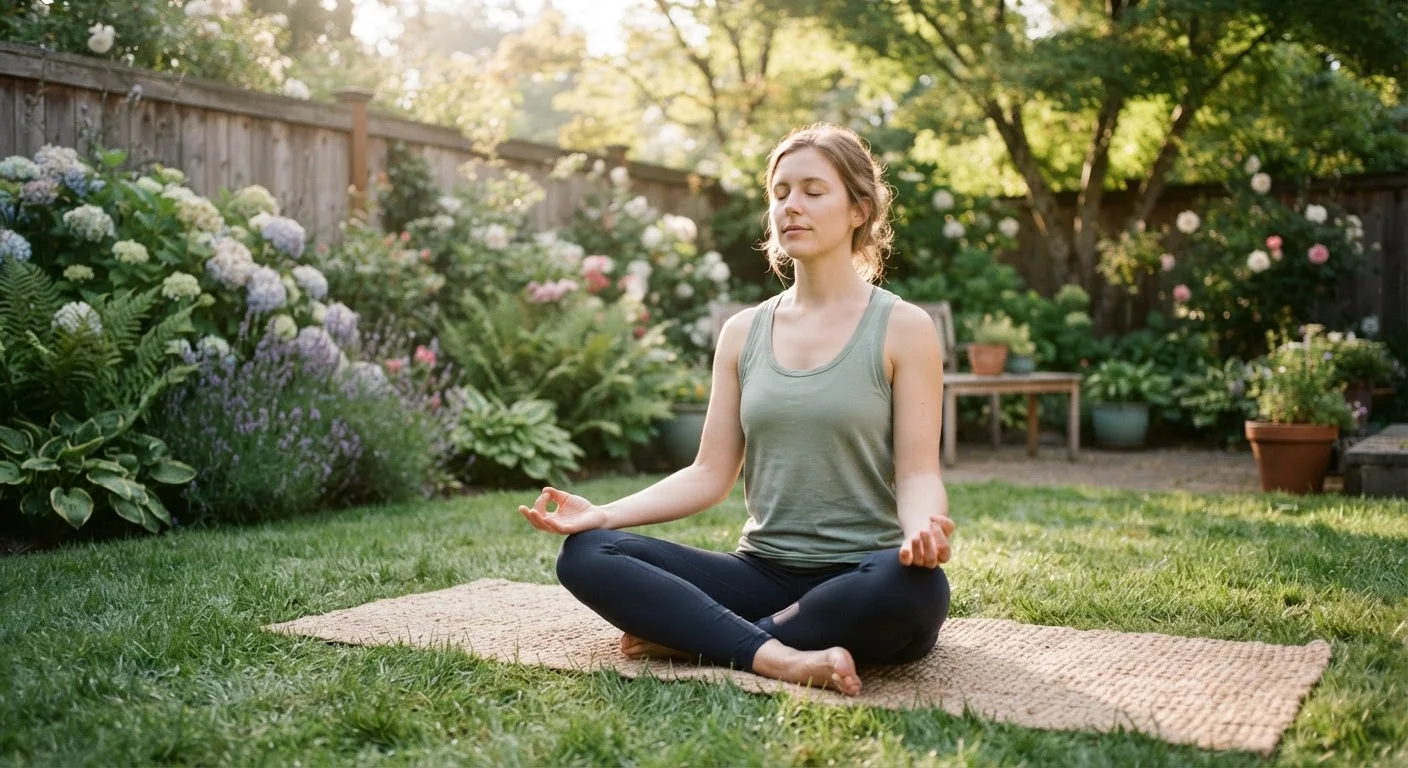
A few minutes of slow, controlled breathing can shift your body out of a stress response without any equipment.
Walking, especially outdoors
Walking is one of the most accessible and well-supported physical activities for managing stress and mood. Time spent in green spaces or natural settings has been associated in multiple research contexts with lower levels of the stress hormone cortisol, though individual results vary.
A 20-30 minute walk several times a week is a reasonable starting point for most adults, though any movement is worthwhile. Community parks, school tracks, and neighborhood sidewalks are all free. Some communities also organize free walking groups through parks and recreation departments or local health departments, which adds a social element.
Walking outdoors in green spaces has been associated with lower cortisol levels in multiple research contexts.
Progressive muscle relaxation
Progressive muscle relaxation involves systematically tensing and releasing muscle groups throughout the body. The technique was developed as a clinical tool and has a long track record in research on anxiety and stress. The process takes about 15-20 minutes and can be done lying on the floor or sitting in a chair.
Guided scripts for this technique are widely available at no cost through university health center websites, public library digital resources, and some state public health portals. It requires no special equipment and no ongoing cost.
Progressive muscle relaxation has a long clinical research track record and requires no equipment or ongoing cost.
Reducing news and social media exposure
Constant exposure to distressing news cycles and comparison-heavy social media feeds can maintain a low-grade state of stress throughout the day. Setting deliberate time limits on news consumption, turning off push notifications, and removing apps from a home screen are practical steps that cost nothing.
This is not about avoidance of important information. A single daily check-in with a trusted news source gives sufficient awareness for most people without the sustained stress load that comes from continuous scrolling. Families can also discuss and model these habits with children.
Setting deliberate time limits on news and social media is a no-cost way to reduce ambient daily stress.
Social connection through community programs
Social isolation is consistently linked to higher stress and worse health outcomes in public health research. Staying connected does not require paid memberships. Public libraries often host free programs for adults and families. Parks and recreation departments run low-cost or free classes. Community centers, faith organizations, and local volunteer groups all provide regular opportunities for face-to-face interaction.
For families looking to find local resources, community health resources that many people do not know about are often available through county health departments and federally funded community health centers.
Public libraries, parks departments, and community centers offer free regular programs that support social connection.
Journaling and expressive writing
Writing about stressful experiences in a structured way has been studied as a tool for processing difficult emotions. The approach commonly associated with this research involves writing continuously for 15-20 minutes about a stressful event, including both the facts and your feelings about it, over several days.
A notebook and pen are the only materials needed. This practice is not a replacement for professional support when stress is severe, but for everyday tension it can help create some mental distance from recurring worries. A simple paper notebook costs very little and lasts for months.
Writing about stressful experiences for 15-20 minutes has been studied as a tool for processing difficult emotions.
Building a routine that sticks
The most effective stress-management habit is one you actually use. Pick one or two approaches from this list and practice them consistently before adding more. Short, repeated practice tends to produce more noticeable results than occasional longer sessions.
Sleep and stress management reinforce each other directly. If stress is interfering with your sleep, sleep hygiene practices are worth pairing with the strategies here. For families facing financial pressure as a stress source, reducing grocery spending is one concrete area where small changes can ease day-to-day strain.
Start small and stay consistent
Picking one technique and using it daily for two weeks will tell you more about whether it works for you than trying several approaches once each. Consistency matters more than duration when building a new habit. Even five minutes of intentional practice is a real starting point.
This article is for general informational purposes only and is not a substitute for professional medical advice. If you are experiencing significant stress, anxiety, or related symptoms, consult a qualified healthcare provider.