
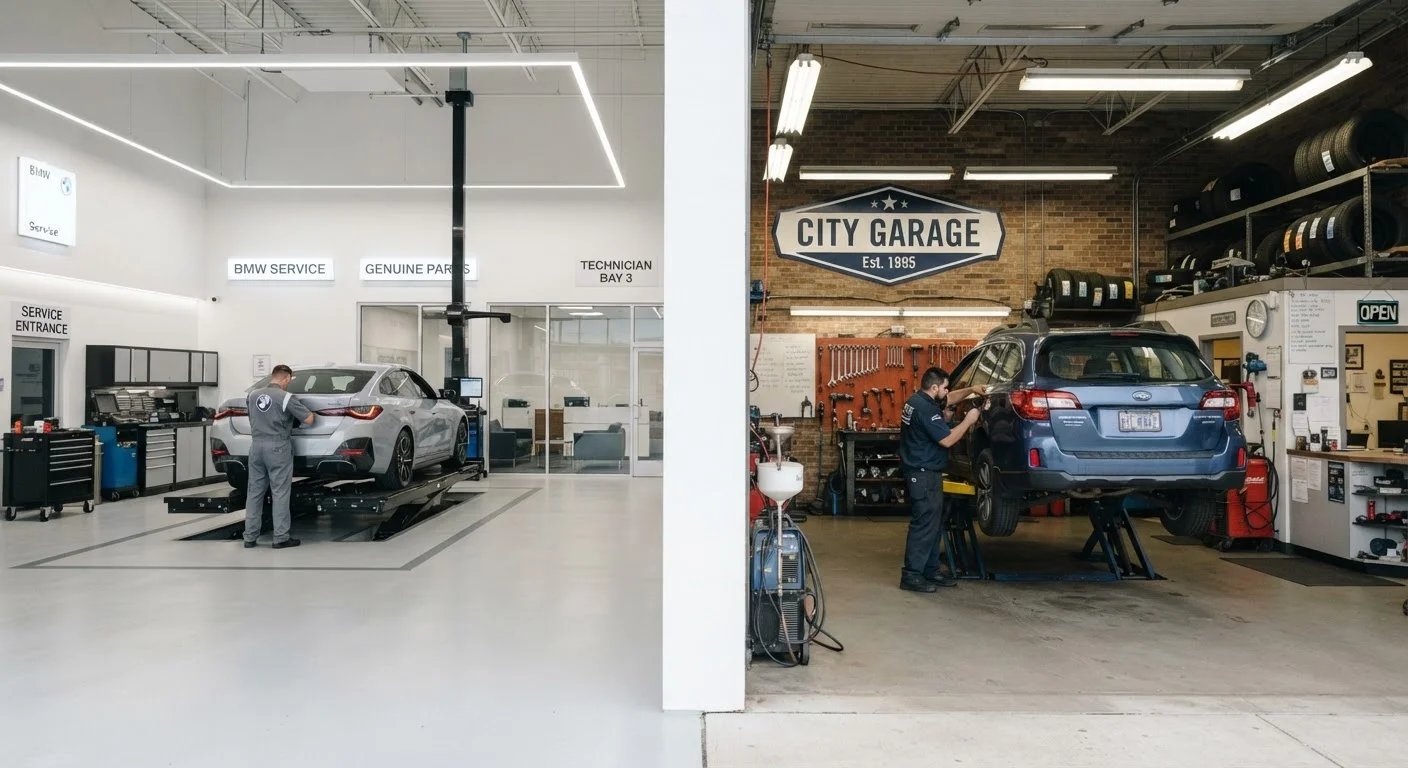
What you are actually paying for at each type of shop
Dealer service centers employ technicians trained specifically on the makes they sell. Those technicians have access to factory diagnostic tools, software update protocols, and original equipment manufacturer (OEM) parts. That specialization has value, but it comes with a cost: dealer labor rates are generally higher than those at independent shops, sometimes by $30 to $60 per hour depending on the region and vehicle brand.
Independent shops vary widely. A well-run independent with ASE-certified technicians (Automotive Service Excellence, a national credentialing program) can handle most of what a dealer does for everyday repairs. Their overhead is usually lower, and those savings tend to flow through to the customer. The gap narrows further when the independent uses quality aftermarket or OEM-equivalent parts rather than the cheapest available.
Labor rate alone does not tell the full story. A dealer might quote two hours for a job an experienced independent completes in 90 minutes, or vice versa. Getting a written estimate from both before authorizing work is a straightforward way to compare real costs. See the guide to evaluating any shop before you commit for specific questions worth asking.
When the dealership is the right call
Three situations tilt the decision clearly toward a dealer. First, if your vehicle is still covered by the manufacturer's bumper-to-bumper or powertrain warranty, warranty repairs must be done at an authorized dealer or a facility the manufacturer approves. Taking covered work to an independent shop means paying out of pocket for something the manufacturer would otherwise cover at no charge.
Second, recall repairs are always free at the dealership and cannot be performed anywhere else. If you receive a recall notice or find an open recall through the National Highway Traffic Safety Administration (NHTSA) database, schedule it at the dealer.
Third, late-model vehicles with complex electronic systems, particularly those with proprietary software, adaptive driver-assist features, or hybrid and electric drivetrains, sometimes require factory diagnostic equipment that most independent shops do not have. For those specific repairs, a dealer technician with manufacturer training is the practical choice.
| Dealer service center | Independent shop | |
|---|---|---|
| Labor rate | Higher (brand and region vary) | Generally lower |
| Technician training | Factory-trained for that make | ASE-certified (varies by shop) |
| Parts used | OEM standard | OEM, aftermarket, or remanufactured |
| Warranty repairs | Required for covered work | Not eligible for warranty claims |
| Recall work | Available at no charge | Cannot perform recall repairs |
| Diagnostic equipment | Factory tools for all systems | May lack proprietary software tools |
| Best for routine maintenance | Capable, but often higher cost | Competitive cost, fully capable |
When an independent shop makes more financial sense
Once a vehicle is out of warranty, the calculus changes. Routine maintenance such as oil changes, tire rotations, brake pad replacements, belt and filter changes, and cooling system flushes does not require dealer-specific tools. A competent independent shop can do all of it, and the total bill is often meaningfully lower.
The Magnuson-Moss Warranty Act, a federal law, also protects consumers on this point: manufacturers cannot void a warranty simply because a consumer used a non-dealer shop for maintenance, provided the shop used parts and fluids meeting the manufacturer's specifications. This is worth knowing if a dealer implies otherwise while your vehicle is still under warranty.
For families with older vehicles carrying no warranty at all, the independent shop is frequently the better financial fit. Car ownership costs that catch families off guard include cumulative service bills, and choosing the lower-cost option for routine work adds up over several years of ownership.
How to evaluate whichever shop you choose
The facility type matters less than the individual shop's practices. Whether you are considering a dealer or an independent, look for ASE certification displayed in the service area, a willingness to provide written estimates before work begins, and clear communication about which parts will be used (OEM, aftermarket, or remanufactured) and why.
A shop that refuses to show you the old parts, cannot explain what was done in plain language, or pressures you to authorize additional work without documentation is a concern regardless of brand affiliation. The framework for finding a trustworthy mechanic covers red flags and evaluation criteria that apply equally to dealer and independent service bays.
Keeping your own service records, regardless of where work is done, also protects you. A written log of every oil change, repair, and inspection supports warranty claims, simplifies future diagnostics, and improves resale value. For a broader picture of the decisions involved across a vehicle's life, the complete family guide to car ownership covers the full arc from first maintenance appointment to trade-in.